The Most Important Maintenance Metric Mean Time to Repair (MTTR) measures how long it takes to fix equipment. Before AI: Average MTTR of 4 hours. After AI: Average MTTR of 2 hours or less. That’s 2 hours saved per incident. With 10 incidents per month at Rs.10 lakhs/hour, that’s Rs.2 Crores in annual savings. Ready to transform your maintenance operations? Visit aimyze.com
The ROI of Predictive Maintenance: A CFO’s Perspective
Speaking the Language of Finance When presenting predictive maintenance to your CFO, focus on hard numbers: Investment of Rs.10-15 lakhs annually, Returns of Rs.1-5 Crores annually, Payback period under 3 months. Unlike major ERP implementations, AI maintenance carries minimal risk: no hardware changes, no process disruption, no rip-and-replace. Ready to transform your maintenance operations? Visit aimyze.com
From Firefighting to Forecasting: A Maintenance Team Journey
A Transformation Story Every maintenance team starts the same way: responding to breakdowns as they happen. True transformation happens when you stop fixing and start preventing. The four stages of maintenance maturity: Reactive, Preventive, Condition-Based, and Predictive/Prescriptive. AI helps you jump directly to the highest level. Ready to transform your maintenance operations? Visit aimyze.com
Your SCADA Data is a Goldmine You’re Not Using
You’re Sitting on a Data Treasure Your SCADA system collects thousands of data points every minute. Temperature, pressure, flow rates, vibration, power consumption – a continuous stream of information about your equipment’s health. But most of this data is never analyzed. AI can process your entire SCADA history and real-time feeds simultaneously, learning what ‘normal’ looks like and alerting you when patterns deviate. Ready to transform your maintenance operations? Visit aimyze.com
Cement Industry: AI-Powered Kiln Maintenance
The Heartbeat of Cement Manufacturing In cement manufacturing, the kiln is everything. When your kiln goes down, production stops completely. With hourly downtime costs of Rs.10-15 lakhs, even a few hours of unplanned outage can devastate monthly targets. AI-powered kiln monitoring can reduce unplanned stops by 30%, extend refractory life by 15-20%, and save Rs.3-8 Crores annually. Ready to transform your maintenance operations? Visit aimyze.com
The Plant Manager’s Guide to AI-Powered Maintenance
Your Complete Introduction to Intelligent Maintenance As a Plant Manager, you’re constantly balancing production targets, safety requirements, cost pressures, and team management. AI-powered maintenance can help on all fronts – but only if implemented correctly. This guide covers everything you need to know. What AI-Powered Maintenance Actually Means AI-powered maintenance uses machine learning algorithms to analyze equipment data (vibration, temperature, pressure, etc.) and predict failures before they happen. Modern “agentic” AI goes further – it can also take actions like creating tickets, assigning technicians, and pulling up relevant documentation. Key Capabilities to Look For Implementation Timeline Traditional AI projects take 12-18 months. Modern agentic AI platforms like Aimyze deploy in 4 weeks: Week 1 – System integration, Week 2 – AI model configuration, Week 3 – User training, Week 4 – Go-live and optimization. Expected Results 30% reduction in unplanned downtime, 80% of routine decisions automated, Rs.1-5 Crores annual savings, 50% reduction in mean time to repair. Ready to transform your maintenance operations? Visit aimyze.com

5 Signs Your Plant Needs Predictive Maintenance Yesterday
Is Your Plant Sending Warning Signs? Every manufacturing plant experiences equipment issues. But how do you know when it’s time to move from reactive firefighting to predictive maintenance? Here are the five warning signs that your plant needs AI-powered predictive maintenance, yesterday. Sign 1: Your Best Technicians Are Always Firefighting If your most skilled maintenance staff spend their days running from one emergency to another, you have a problem. These experts should be focused on improvements and preventive work, not constantly putting out fires. The cost: Burnout, turnover, and loss of institutional knowledge. Sign 2: You Keep Repairing the Same Equipment When certain machines fail repeatedly, it’s not bad luck, it’s a pattern your current approach isn’t catching. Without predictive analytics, you’re treating symptoms instead of root causes. Sign 3: Downtime Events Are Increasing Track your unplanned downtime over the past two years. If the trend line is going up, your equipment is aging faster than your maintenance approach is evolving. Sign 4: Spare Parts Inventory is Unpredictable Either you’re constantly expediting emergency parts at premium prices, or you’re sitting on excess inventory that ties up working capital. Both scenarios indicate a lack of predictive visibility. Sign 5: You Can’t Answer Basic Questions Quickly When leadership asks “What’s our maintenance cost per unit?” or “Which equipment is most likely to fail next month?” can you answer in minutes, or does it take days of spreadsheet work? What to Do About It If you recognized three or more of these signs, it’s time to seriously evaluate predictive maintenance solutions. The good news: modern agentic AI platforms can be deployed in weeks, not years, and deliver ROI within months. Ready to transform your maintenance operations? Visit aimyze.com
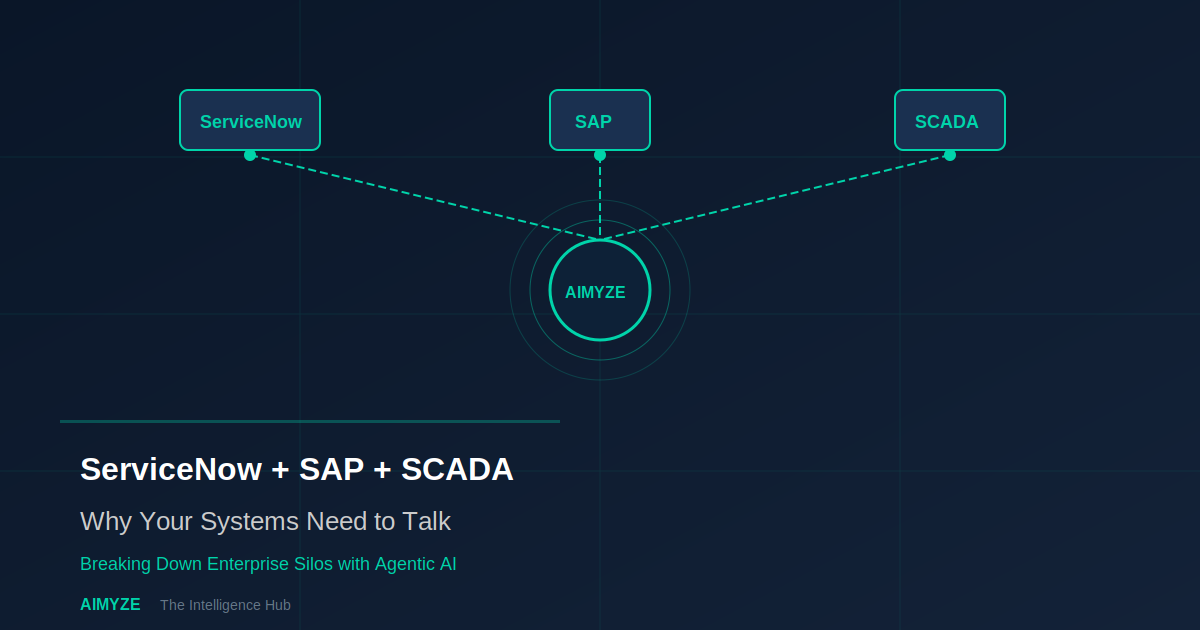
ServiceNow + SAP + SCADA: Why Your Systems Need to Talk to Each Other
The Three Kingdoms Problem Walk into any large Indian manufacturing enterprise and you’ll find three powerful systems, each ruling its own domain: Each system is excellent at what it does. Together, they represent millions of rupees in investment and years of customization. But here’s the problem: they don’t talk to each other. What Happens in Silos When a machine starts showing abnormal behaviour, here’s the typical flow: Time elapsed: 60-90 minutes before anyone starts actual troubleshooting. The Integration Dream vs Reality IT leaders have tried to solve this problem. The typical approaches: The result? Most plants still operate with siloed systems and manual bridging. The Agentic AI Solution Aimyze takes a different approach. Instead of replacing or rebuilding, we add an intelligent layer on top that: Deployment time: 4 weeks. Not 18 months. What Integration Actually Looks Like With Aimyze, that same Pump-07 scenario plays out differently: Time elapsed: Under 2 minutes. Raj is already walking to the pump. The Bottom Line Your systems have data. Your people have expertise. What’s missing is the intelligent bridge that connects everything. That bridge doesn’t require replacing what you have. It just makes what you have smarter. See how Aimyze connects your systems. Book a demo at aimyze.com
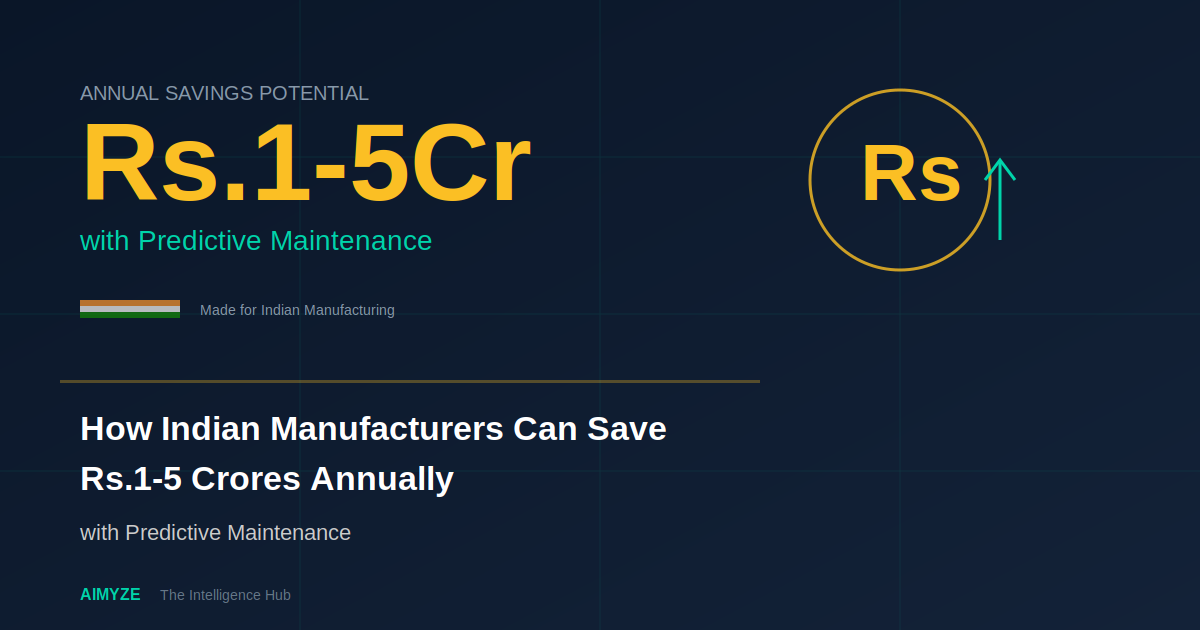
How Indian Manufacturers Can Save Rs.1-5 Crores Annually with Predictive Maintenance
The Promise Sounds Too Good When we tell plant managers that Aimyze can help them save Rs.1-5 crores annually, we often see skepticism. And that’s fair – the enterprise software industry has made a lot of promises over the years. So let’s break down the math. No hand-waving. Just numbers. Savings Source 1: Reduced Unplanned Downtime This is the biggest lever. Let’s use a mid-sized cement plant as an example: Conservative estimate for most facilities: Rs.1-3 crores from downtime reduction alone. Savings Source 2: Maintenance Efficiency When AI handles ticket creation, assignment, and context gathering, your maintenance team becomes dramatically more efficient: Savings Source 3: Extended Equipment Life Catching problems early means less severe damage: Savings Source 4: Lower Software Costs This is where Aimyze’s India-first approach really shines: Total Annual Impact Savings Category Annual Savings Reduced Downtime Rs.1-3 Crores Maintenance Efficiency Rs.6-12 Lakhs Extended Equipment Life Rs.20-50 Lakhs Software Cost Savings Rs.25-45 Lakhs TOTAL Rs.1.5-5 Crores The Payback Period With Aimyze’s annual cost of Rs.10-15 lakhs and savings of Rs.1-5 crores, the payback period is typically less than 3 months. That’s not ROI. That’s a no-brainer. Get a customized ROI analysis for your plant. Contact us at aimyze.com
Agentic AI vs Traditional AI: What’s the Difference and Why It Matters
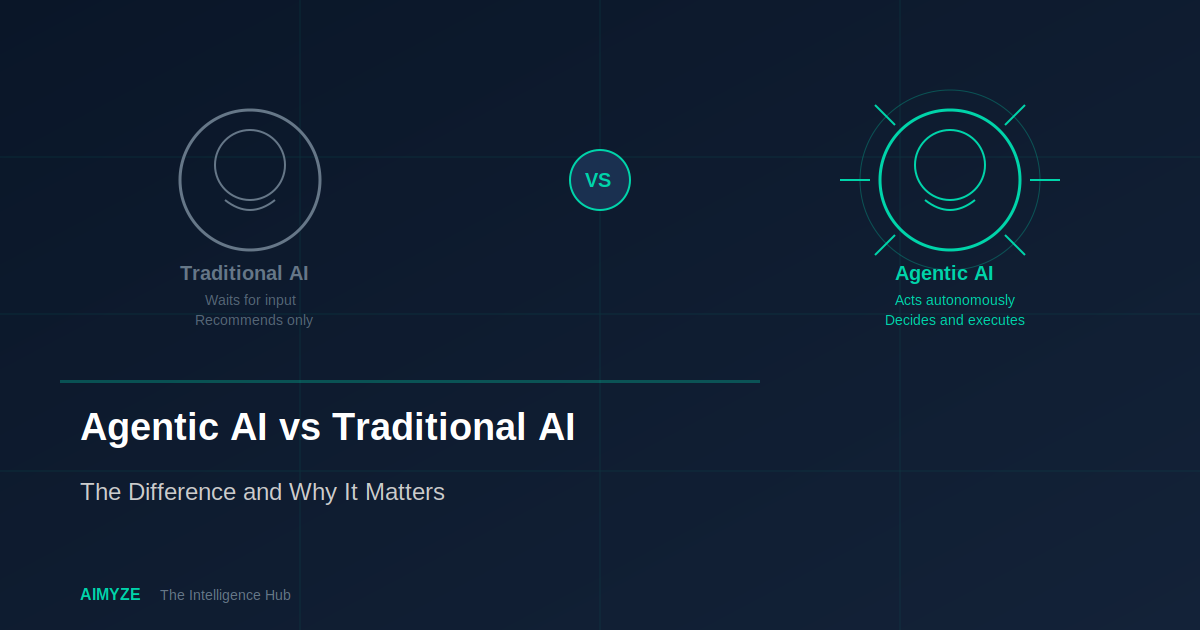
The AI Revolution Has Entered a New Phase If you’ve been following AI developments, you’ve probably heard about ChatGPT, machine learning, and predictive analytics. These technologies have transformed how businesses operate. But there’s a new paradigm emerging that goes beyond simple prediction and recommendation. It’s called Agentic AI – and it’s about to change enterprise operations fundamentally. Traditional AI: The Assistant Traditional AI systems, even sophisticated ones, operate on a simple principle: you ask, they answer. Think of it like having a very smart assistant: The key limitation? Human involvement at every step. Someone needs to query the system, interpret results, make decisions, and execute actions. Agentic AI: The Autonomous Operator Agentic AI systems are fundamentally different. They can: Think of it less as an assistant and more as a junior team member who can work independently on well-defined tasks. A Side-by-Side Comparison Capability Traditional AI Agentic AI Initiation Waits for human input Proactively monitors Decision Making Recommends options Decides and executes System Scope Single system focus Multi-system integration Human Role In every loop Oversight on exceptions Why This Matters for Manufacturing In a manufacturing context, the difference is transformative: Traditional AI says: “The pump vibration is abnormal. Here’s a report.” Agentic AI does: Detects anomaly → Checks equipment history → Creates ServiceNow ticket with context → Assigns technician Raj (who has pump certification and is on shift) → Sends WhatsApp alert → Schedules maintenance window during low production → Updates SAP records. The first gives you information. The second gives you resolution. The Bottom Line Agentic AI isn’t just an incremental improvement – it’s a step change in how AI delivers value. For manufacturing enterprises drowning in data but starving for action, it represents the future of operations. Experience agentic AI in action. Book a demo at aimyze.com